Event Planning Checklist: The Complete Timeline From 12 Months Out to the Day After
A complete event planning checklist, phase by phase: what to lock in 12 months out, what to confirm in the final two weeks, and what most teams forget after the event ends.
TL;DR
An event planning checklist works best as a timeline: lock goals, budget and venue 12 to 6 months out; build the program and registration 6 to 3 months out; drive promotion and logistics in the last 3 months; confirm every registrant in the final two weeks; run check-in and live questions on the day; and close the loop within 72 hours.
 ChatGPT
 Claude
 Perplexity
 Grok
 Google AI
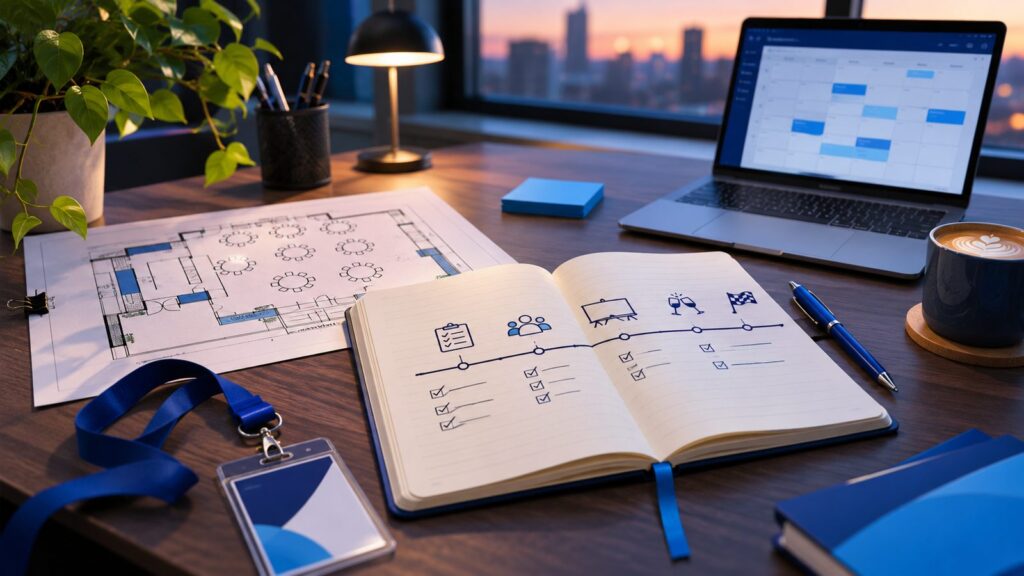
This event planning checklist is organized as a timeline, from 12 months before the event to the 72 hours after it. Each phase ends with a clear finish line, so you always know what has to be done before you move on. Use it for conferences, corporate events, summits and trade shows; the section on conferences covers what changes when you run multiple tracks.
What Is an Event Planning Checklist?
An event planning checklist is a list of every task needed to plan, run and close an event, ordered by when each task has to happen. A good one does two jobs: it stops things from being forgotten, and it shows which decisions have to be made early because everything else depends on them.
The order matters more than the length. The date, venue and budget limit almost every later choice, while attendee communication in the final two weeks decides how many registrants actually arrive.
12 to 6 Months Out: Goals, Budget and Venue
This phase sets the limits for everything that follows.
- Write down the event goal in one sentence (for example, pipeline from customers, education for members, or a product launch).
- Decide how you will measure success: attendance, attendance rate, leads, sponsor revenue, satisfaction score.
- Set the total budget and the main budget lines: venue, catering, production, travel, marketing, technology and a contingency of 10 to 15 percent.
- Estimate the audience size and who they are.
- Shortlist dates and check them against holidays and competing industry events.
- Send venue requests, visit the shortlist and sign the venue contract. Read the attrition and cancellation clauses carefully.
- Book hotel room blocks if attendees travel.
- Choose your event platform for registration and ticketing.
- Assign one owner for each area: program, marketing, sponsors, logistics and attendee communication.
Finish line: signed venue contract, approved budget and named owners.
6 to 3 Months Out: Program, Speakers and Registration
- Draft the agenda and the session format (keynotes, panels, workshops, networking).
- Invite keynote speakers first; open a call for speakers if you run one.
- Create the sponsor and exhibitor packages and start outreach.
- Build the event website and registration pages.
- Decide the registration fields. Ask only for what you will use, and collect a mobile number with consent if you plan to send texts or WhatsApp messages.
- Set ticket prices and early-bird deadlines.
- Book the main vendors: catering, audio-visual, production, photography, security.
- Plan accessibility: venue access, captioning, dietary needs.
- Write the attendee communication plan: what goes out at registration, one week before, two days before, the morning of and after the event, and on which channel.
Finish line: registration open, keynotes confirmed and the communication plan approved.
3 to 1 Months Out: Promotion, Sponsors and Logistics
- Run the promotion plan: email, social, partners, speakers sharing their sessions, paid ads if budgeted.
- Track registrations weekly against your target and adjust promotion early.
- Confirm all speakers and collect bios, photos and slides.
- Close sponsor and exhibitor deals and send them their own deadlines and logistics.
- Finalize the floor plan, room setups and signage.
- Order badges, lanyards and printed materials.
- Prepare the event app or attendee portal if you use one.
- Set up answers to common attendee questions (parking, transit, agenda, Wi-Fi, dress code, accessibility) so they are ready for the website, the help desk and any chatbot.
- Brief staff and volunteers on roles.
Finish line: final agenda published, sponsors confirmed and every logistics vendor booked.
The Final Two Weeks: Confirmations and Reminders
This is the phase that decides attendance, and it is the one most often reduced to a single reminder email. Registrants who were keen in month two can easily drift by event week. Our guide to the no-show rate explains how to measure the gap.
- One week before: send a logistics reminder with the venue, times, parking or transit, and the agenda highlights.
- Confirm attendance personally where it matters: a short call or WhatsApp message asking “Are you still able to make it?” surfaces cancellations early and frees seats for the waitlist.
- Two days before: send a short reminder by text or WhatsApp, not only email.
- Give final numbers to catering and the venue.
- Print badges for confirmed attendees and plan for walk-ins.
- Run a technical rehearsal for sessions, streaming and presentations.
- Prepare the run of show with times, owners and backup plans.
Ready-to-use wording for each of these messages is in our event reminder templates.
Finish line: confirmed attendee list, final numbers to vendors and a tested run of show.
Event Day: Check-In, Questions and Live Changes
- Open check-in early, with a separate desk for speakers, VIPs and sponsors.
- Send a morning-of message with the start time and one useful detail.
- Staff a single place for attendee questions and expect a spike at the start of the day and at breaks.
- Announce schedule changes on every channel at once: app, screens, text or WhatsApp.
- Track attendance by session to see what worked.
- Keep one person free to handle problems instead of running a session.
Finish line: every session ran, and every question and issue was logged.
The 72 Hours After: Follow-Up, Feedback and Reporting
The event is not over when the room empties. The days after it are when attendees remember it best and when the next event’s registrations start.
- Within a day: send a thank-you message to attendees, speakers, sponsors and staff.
- Within a day or two: send the feedback survey while the event is fresh. Our list of post-event survey questions covers what to ask.
- Send no-shows a separate message with the recordings or slides.
- Share session recordings and slides with attendees.
- Pass leads to sales and send sponsors their results.
- Pay vendors and reconcile the budget.
- Write the report: attendance rate, satisfaction, leads, revenue and what to change. See how to measure attendance beyond registration.
Finish line: report shared and the date for the next event pencilled in.
Conference Planning Checklist: What Changes for Multi-Track Events
A conference uses the same phases, with extra work in the program and on event day.
- Open the call for speakers 6 to 9 months out and set clear review criteria.
- Build the session grid by track and check room capacity against expected interest.
- Let attendees pick sessions in advance so you can move popular talks to bigger rooms.
- Brief speakers on timing, slides and session format two weeks before.
- Plan for many more questions on event day: rooms, times, recordings and changes.
- Track attendance per session, not just at the door.
For more on running conferences, see AI for conferences.
Where AI Fits in the Checklist
Most of this checklist is decisions only your team can make: the venue, the program, the people on stage. The parts that eat the most hours are repetitive communication: confirming who is still coming, answering the same questions again and again, sending reminders and chasing feedback.
That is where AI helps. KATHN, built by KNVI Labs, confirms attendance by AI voice call and WhatsApp, answers attendee questions on your website and messaging channels, and collects feedback after the event, with every conversation logged for your team. If you want to see where AI would save your team the most time, the AI readiness assessment takes a few minutes.
Key Takeaways
- Plan in phases, not one long list: each phase has a clear finish line.
- The venue, date and budget decisions 12 to 6 months out limit every later choice.
- The final two weeks decide attendance: confirm registrants on more than one channel, not just email.
- Event day needs a plan for questions, not just a run of show.
- The 72 hours after the event are part of the event: thank, survey and report while it is fresh.
How We Can Help You?
KATHN
KATHN is an AI communication and orchestration platform for events, built by KNVI Labs.
Frequently Asked Questions
For a conference or large corporate event, start 9 to 12 months out so you can secure the venue, date and key speakers. A smaller internal meeting or webinar can be planned in 6 to 8 weeks. The bigger the venue and the more people travel, the earlier you need to start.
Goals and budget, date and venue, program and speakers, registration, promotion, sponsors and exhibitors, vendors and logistics, attendee communication (confirmations, reminders and day-of answers), event-day staffing and check-in, and post-event follow-up, survey and reporting.
A conference planning checklist adds the work that comes with multiple sessions and tracks: a call for speakers, session scheduling, room capacity planning, speaker briefings, and session-level attendance tracking. The core phases are the same.
Three things come up again and again: confirming attendance in the final week instead of assuming registrants will show up, staffing for the spike in attendee questions on event day, and following up within 72 hours after the event.
Yes, mostly in the communication-heavy steps. AI can confirm attendance by phone or WhatsApp, answer attendee questions around the clock, send timed reminders and collect feedback after the event, which frees the team for venue, program and on-site work.